
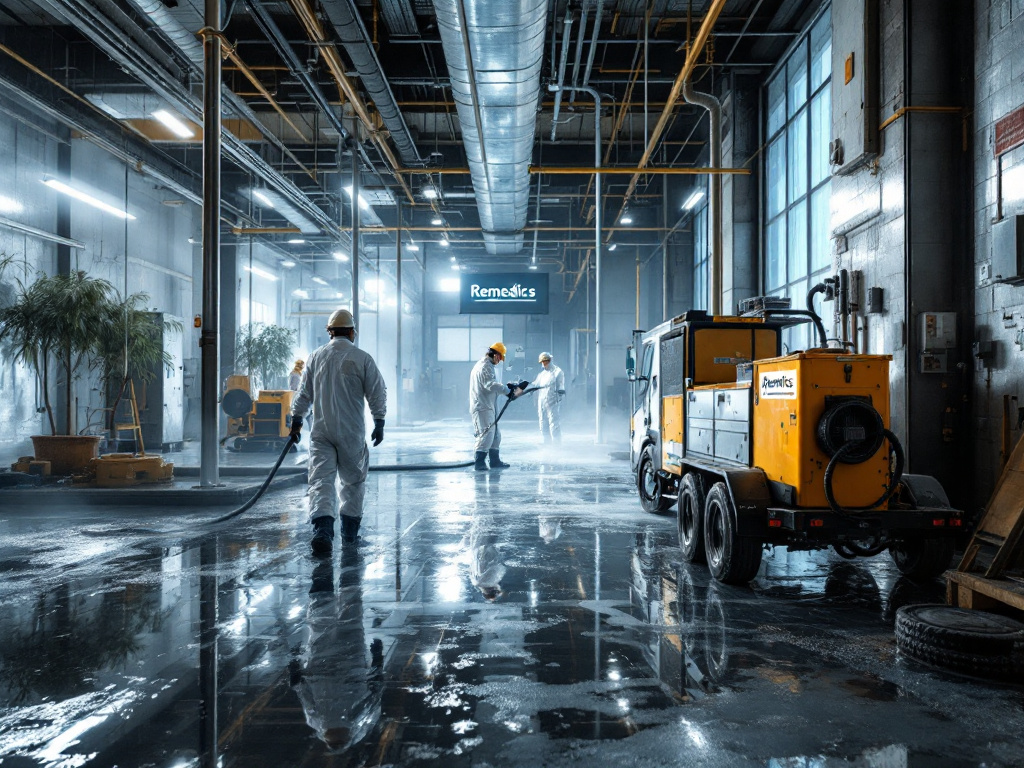
Understand industrial water damage cleanup
When industrial water damage cleanup isn’t handled promptly and professionally, your facility faces prolonged downtime, revenue loss, and compliance risks. You need a partner who moves quickly to extract standing water, mitigate hazards, and restore your property so you can resume operations without missing a beat. By coordinating advanced extraction, drying, and decontamination workflows, Remedics helps you avoid costly interruptions and maintain a safe environment for employees and equipment.
Industrial water incidents range from burst pipes in manufacturing lines to flooding in warehouse bays. Each scenario demands a structured response: hazard assessment, water removal, moisture monitoring, and comprehensive restoration. Whether you manage a commercial high-rise, school building, retail chain, or industrial plant, a robust cleanup plan seals your facility against structural damage, mold growth, and regulatory fines.
Prepare for rapid response
Conduct hazard assessment
Before extraction begins, your team must identify immediate risks. Electrical hazards, structural instability, and contaminated water sources (Category 2 gray water or Category 3 black water) pose threats to worker safety and equipment integrity. A thorough inspection ensures that power is disconnected, gas lines are secured, and splash zones are restricted. This initial step safeguards personnel and prevents secondary damage.
Mobilize emergency restoration
When seconds count, Remedics activates its commercial emergency restoration response team. You’ll receive 24/7 support from certified technicians who arrive with personal protective equipment (PPE) such as N-95 masks, gloves, goggles, and rubber boots to handle gray or black water safely. Rapid deployment minimizes water spread and sets the stage for efficient cleanup.
Deploy extraction equipment
Truck-mounted water extractors
For large volumes of standing water—often hundreds or thousands of gallons—you need truck-mounted water extractors. These powerful units combine high-capacity pumps with extraction wands to remove water from floors and subfloors quickly. While they require regular maintenance and represent a significant investment for restoration firms, they deliver unmatched extraction rates on major loss events [1].
Portable extractors and attachments
In confined or upper-level spaces, portable water extractors fitted with water claw attachments offer flexibility. You can tackle water pooling in server rooms, office suites, and commercial kitchens without waiting for truck access. These units are especially useful for quick response in multi-unit properties where downtime tolerance is low [1].
Subsurface extraction tools
To extract water trapped beneath concrete or tile, Remedics uses professional-grade tools like the SOS FLUSH PRO Sub Surface Extraction Tool by StainOut System. This device flushes and vacuums deep water layers in porous materials, ensuring thorough removal and reducing the risk of hidden moisture pockets [2].
Accelerate structural drying
Deploy dehumidifiers and air movers
Once standing water is gone, you must control moisture levels. Industry guidelines recommend pairing seven to eight high-capacity air movers with each extra-large dehumidifier, or ten air movers with two large dehumidifiers, to optimize airflow and drying [1]. LGR dehumidifiers like the Dri-Eaz LGR 7000 XLi harness cross-flow technology to extract water even in low-humidity environments [2].
Use air filtration devices
To maintain air quality, place one 500 CFM air filtration device (AFD) per extra-large dehumidifier or every two large units. Strategically positioning smaller AFDs in adjacent rooms helps capture aerosolized particulates before and during the drying process. This approach limits the spread of contaminants and protects staff health [1].
Leverage high-volume drying
For extensive loss scenarios, Remedics deploys commercial high-volume drying services. These include industrial fans and specialized desiccant dehumidifiers that operate efficiently in large open areas. By customizing airflow patterns and humidity targets, you accelerate drying timelines while avoiding over-drying and material stress.
Integrate monitoring workflows
Employ moisture meters and thermography
Detecting hidden moisture is critical to prevent mold and structural damage. Digital moisture meters and infrared thermal cameras reveal damp areas behind walls, under floors, and within ceiling cavities. Documenting readings with photos ensures a transparent record for stakeholders and insurance purposes [3].
Use digital reporting tools
Mobile apps like magicplan streamline documentation by generating instant floor plans and embedding moisture logs directly into your reports. You can share real-time updates with your team and clients, seamlessly integrating with estimating software such as Xactimate® and CoreLogic. This collaboration reduces site visits and keeps everyone aligned on progress [3].
Manage large-loss compliance
Address class 4 scenarios
Class 4 water damage involves low-permeability materials such as concrete, brick, and plaster that trap moisture deep within. These cases require specialized drying methods—heat-drying systems, desiccant dehumidification, and targeted airflow—to extract water effectively [4].
Follow safety protocols
Before remediation, perform hazard inspections to identify electrical risks, chemical spills, and structural weaknesses. Require PPE for all technicians when handling Category 3 black water or mold-laden debris. Remedics’ standard operating procedures align with ANSI S500 guidelines to ensure both safety and compliance throughout the restoration journey.
Document compliance and reporting
Accurate photo documentation, annotated moisture readings, and damage diagrams support insurance claims and regulatory filings. Your restoration plan outlines timelines, equipment needs, and safety measures, giving you full visibility into the project scope and costs [4].
Prevent mold contamination
Use HEPA vacuums
Prior to drying, HEPA-equipped vacuums—particularly backpack models—remove aerosolized particulates and mold spores. This pre-treatment step reduces health risks and sets the stage for effective antimicrobial applications in fire- or water-affected areas [1].
Apply antimicrobial cleaning
After water removal, Remedics applies EPA-registered antimicrobial solutions to sanitize surfaces exposed to gray or black water. This process halts mold growth and eliminates odor, preparing your facility for reconstruction or normal occupancy. When mold issues arise, our commercial mold remediation company team coordinates containment, removal, and prevention strategies.
Choose Remedics restoration
Your trusted cleanup partner
You need a restoration provider who understands commercial scale and compliance demands. Remedics brings decades of experience in commercial water damage restoration services, ensuring every project—from warehouse flooding to office suite leaks—is managed with precision and transparency.
Comprehensive commercial services
Beyond water removal, our offerings include:
- commercial flood cleanup and extraction
- commercial structural drying services
- commercial decontamination and sanitization
- commercial reconstruction services
This end-to-end approach reduces vendor management hassles and speeds your return to business as usual.
Large-scale coordination
For multi-unit properties or industrial complexes, Remedics implements centralized project management. You receive a dedicated account manager, daily progress reports, and real-time collaboration via digital tools. Our large-loss restoration for businesses ensures consistent execution across multiple zones and phases, preventing miscommunication and costly delays.
Minimize downtime costs
Calculate ROI of swift action
Industry data shows mold can begin to grow within 24–48 hours after water exposure, driving remediation costs up to $2,225 on average [5]. Early intervention reduces material replacement needs and labor hours, translating to faster revenue recovery.
Integrate facility restoration
By combining water mitigation, mold remediation, and structural drying, you achieve comprehensive recovery under one contract. Our integrated solution aligns with your facility’s operating hours, so repairs and maintenance occur with minimal disruption to staff and customers.
Ensure business continuity
Remedics’ focus on safety compliance and detailed reporting supports your internal audits and insurance reviews. With transparent scopes of work, you avoid unexpected change orders and maintain budget control. This disciplined approach protects your bottom line and reputation.
Conclusion
Industrial water damage cleanup is not just about removing water—it’s about preserving your operations, safeguarding assets, and ensuring compliance. With Remedics’ coordinated workflows, advanced equipment, and proven protocols, you can avoid costly downtime and get your facility back up and running with confidence. Contact our team today to discuss how Remedics can tailor a rapid, compliant restoration plan for your commercial property.


